

Table of Contents
- Is Brushless Really Going Mainstream at the Entry Level?
- Does this mean brushed motors are going away entirely?
- Why Are Belted Tires Becoming Standard Instead of a Mod?
- What’s Driving the Licensed Body Boom in Scale Crawling?
- Why do licensed bodies specifically drive repeat purchases better than other upgrades?
- Is 1/18 Scale Actually Worth Watching?
- Watch: The 1/18 Scale Trend in Action
- Is There a Fifth Trend Worth Watching?
- What should a shop do differently because of this blurred line?
- What Does This Mean for Parts and Accessories Sales?
- What Should Shops Do About All This?
- Frequently Asked Questions
- Do I need to replace my entire inventory to keep up with these trends?
- Which of these four trends matters most for a small shop with limited budget?
- Is 1/18 scale a passing fad or a real long-term category?
- How do I stay on top of trends like this without spending all day researching?
- Where should I start if I only have time to act on one of these trends this quarter?
A couple weeks back I wrote about specific new releases worth paying attention to this season. This time I want to zoom out, because underneath the individual trucks there are a few bigger shifts happening in RC right now that matter more than any single model, especially if you’re the one deciding what goes on a shop’s shelves.
Is Brushless Really Going Mainstream at the Entry Level?
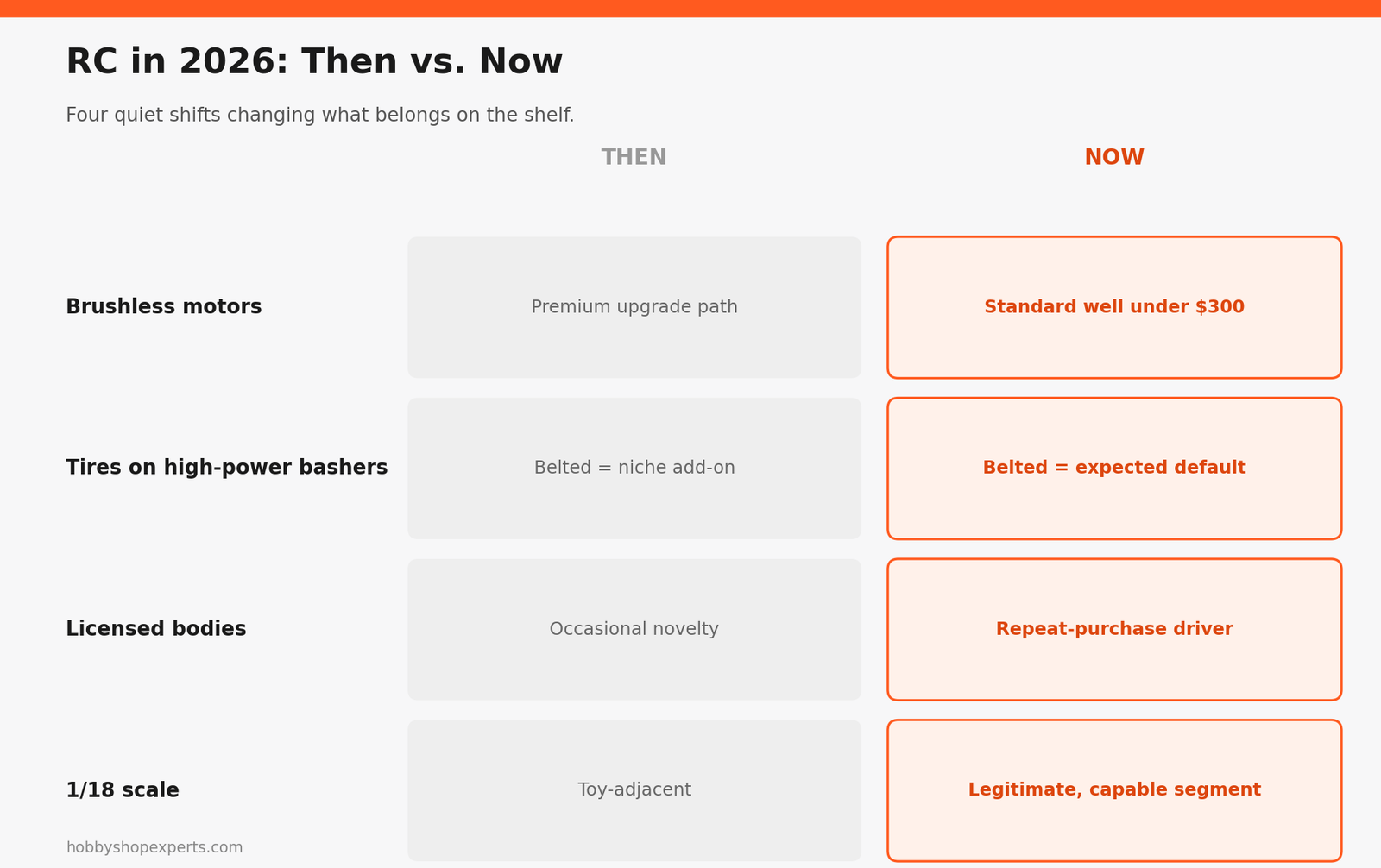
The first is brushless going mainstream at the low end. For years, brushless was the upgrade path: you started brushed, learned the hobby, and eventually “graduated” to brushless once you knew you were sticking with it. That whole narrative is breaking down now that brushless is showing up standard well under the $300 mark. Customers researching online before they ever walk into a shop already know this, and if your sales floor is still pitching brushed-then-upgrade as the default path, you’re going to sound behind the times to anyone who’s done five minutes of homework. I answer the brushed-vs-brushless question in more practical detail, beginner by beginner, in The RC Questions I Get Asked Most.
Does this mean brushed motors are going away entirely?
Not entirely, but their role is shrinking to the very bottom of the price range and to specific use cases like young or budget-conscious beginners who benefit from the extra forgiveness. As brushless components keep getting cheaper, that remaining niche keeps getting smaller too.
Why Are Belted Tires Becoming Standard Instead of a Mod?
The second shift is belted tires moving from specialty upgrade to expected default on high-power bashers. When a flagship truck ships with belted tires standard instead of as an add-on, that resets customer expectations across the whole category, not just for that one model. If your tire wall still treats belted options as a niche upgrade rather than a baseline expectation for anyone running serious power, you’re going to have customers asking why they need to special order something that should probably already be in stock. This is one of several specific product-level shifts I go through in more detail in What’s Actually Worth Stocking This Fall, including exactly which current models are leading this shift.
What’s Driving the Licensed Body Boom in Scale Crawling?
The third is the growth of licensed body partnerships, especially in scale crawling. A newly licensed body on an existing platform isn’t just a cosmetic refresh, it’s often the reason a customer who already owns that platform comes back in and buys another one. If you’re not paying attention to which licenses are landing on which chassis, you’re missing an easy reason to bring repeat customers back through the door.
Why do licensed bodies specifically drive repeat purchases better than other upgrades?
Because the barrier to buying is so low. The customer already owns the chassis, radio, and electronics, so a new licensed body is a relatively cheap, high-satisfaction purchase compared to buying an entirely new platform. It scratches the same “new truck” itch at a fraction of the cost and commitment, which makes it a much easier impulse purchase to say yes to.
Is 1/18 Scale Actually Worth Watching?
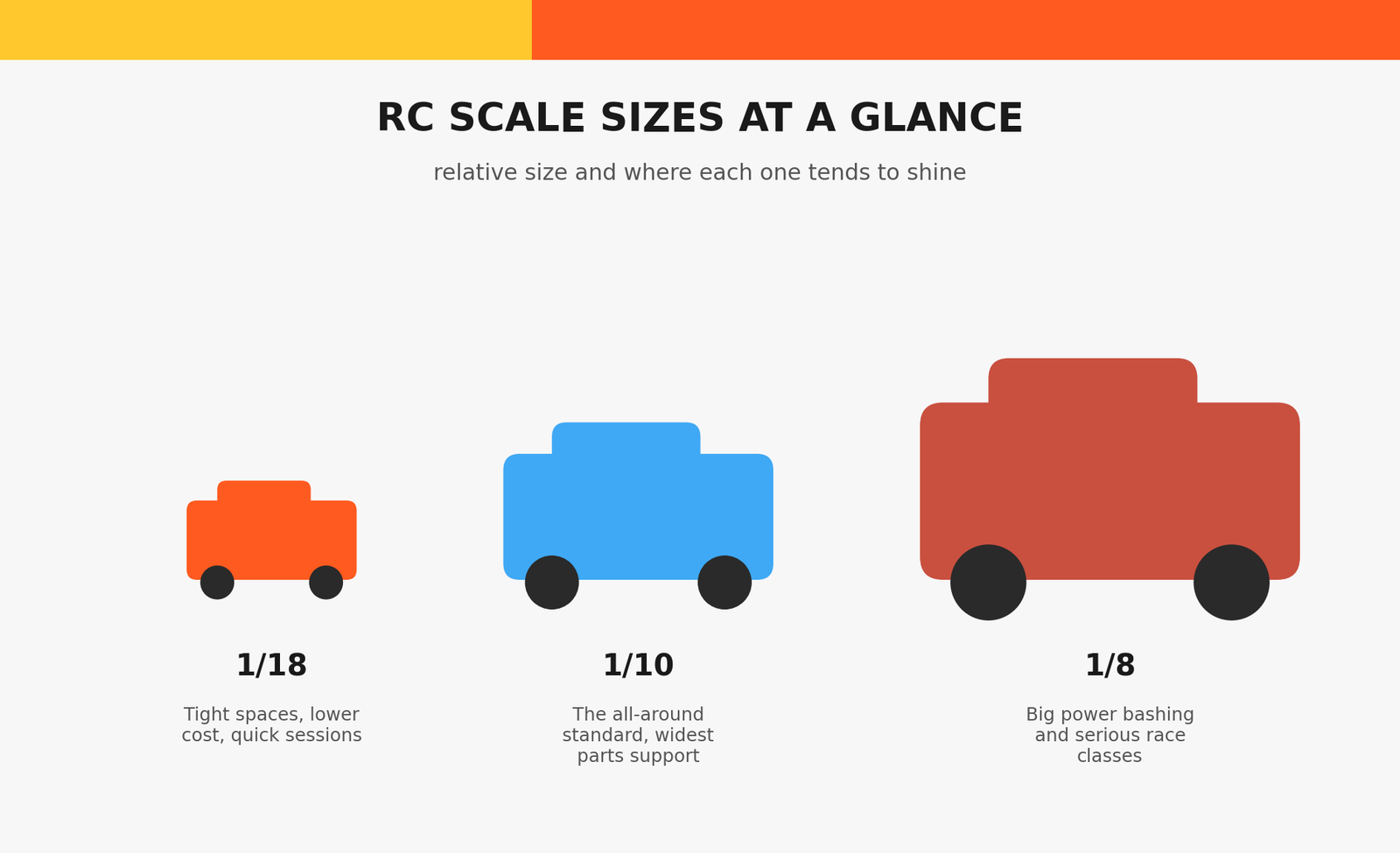
And the fourth, quieter than the others but worth watching, is real growth in the 1/18 scale segment. Smaller, more affordable, easier to run in tighter spaces, and increasingly capable instead of feeling like a toy. That’s a meaningful opportunity for shops in areas without a lot of open space for bashing, or for customers who want something they can run without a full afternoon set aside for it.
Here’s a quick side-by-side of how much has actually shifted across all four of these trends compared to just a few years ago:
Watch: The 1/18 Scale Trend in Action
If you haven’t spent time with a modern 1/18 scale rig, it’s worth seeing one run to understand why this segment is gaining real traction instead of staying a novelty. This review of the Traxxas TRX-4M Ford Bronco is a good look at just how capable this scale has become:
For deeper specs and background on some of the specific platforms mentioned here, both Traxxas and Arrma keep detailed product pages and technical breakdowns for their current lineups, and RC Driver’s racing news section is a good independent source for tracking how the wider hobby is reacting to these shifts in real time.
Is There a Fifth Trend Worth Watching?
Quietly, yes: the line between RTR (ready-to-run) and kit-building is blurring in an interesting way. A few years ago, “kit builder” meant a serious hobbyist willing to spend a weekend with a manual and a parts tray, while everyone else bought RTR and drove it out of the box. Now there’s a growing middle group of customers who buy an RTR truck specifically because they plan to immediately start swapping parts, upgrading electronics, or customizing the body, treating the RTR as a starting kit rather than a finished product. That’s a meaningful shift in how shops should think about their parts wall, since it means even RTR buyers are increasingly good prospects for upgrade parts, not just replacement parts after a crash.
What should a shop do differently because of this blurred line?
Don’t assume RTR customers only need crash parts. Ask what they’re planning to do with the truck at the point of sale, the same way you’d ask a kit builder, and you’ll often find an upsell opportunity in upgraded electronics, wheels, or shocks that a purely transactional checkout would have missed entirely.
What Does This Mean for Parts and Accessories Sales?
Every one of these four trends quietly reshapes what belongs on your parts wall, not just what trucks sit in your front window. Brushless-as-standard means more customers need compatible high-voltage-capable chargers and batteries earlier in their ownership, not as a later upgrade. Belted tires becoming default means your tire and wheel inventory needs to shift accordingly, or you’ll be constantly special-ordering what should be routine stock. Licensed bodies mean your body and decal selection needs to track which platforms are getting the most active licensing attention, since that’s where repeat body sales are concentrated. And growth in 1/18 scale means a whole tier of smaller, less expensive replacement parts and batteries that a shop built entirely around 1/10 scale inventory might be underserving.
None of this requires guessing. It requires paying attention to which of your existing customers are asking about which of these categories, and letting that steer what you add to your next order before a competitor or an online retailer captures that demand instead.
What Should Shops Do About All This?
None of these trends mean you need to overhaul your whole shop. They mean the assumptions a lot of us built our stocking habits around five years ago are quietly getting outdated, one product cycle at a time. The shops paying attention to why these shifts are happening, not just what’s new this month, are the ones that’ll be ready before their customers even ask. If you’re not sure whether your current stocking mix still matches where the hobby is actually heading, that’s a natural thing to walk through in a free store audit and strategy call.
Frequently Asked Questions
Do I need to replace my entire inventory to keep up with these trends?
No. These are gradual shifts in customer expectations, not a hard cutoff. The goal is adjusting what you reorder and how you talk to customers over the next few buying cycles, not clearing your shelves overnight.
Which of these four trends matters most for a small shop with limited budget?
Usually the brushless-at-entry-level shift, because it directly affects how you position your beginner aisle and the pitch your staff gives to first-time buyers, which touches nearly every new customer that walks in the door.
Is 1/18 scale a passing fad or a real long-term category?
It has the hallmarks of a real category rather than a fad: genuine capability improvements, growing platform support from major brands, and a clear use case (space-constrained running) that isn’t going away. It’s still smaller than 1/10 scale, but it’s a legitimate opportunity, not a novelty.
How do I stay on top of trends like this without spending all day researching?
Following manufacturer release announcements and a couple of trusted independent review sources goes a long way. It’s also exactly why I write this blog. If it’s useful, I’d rather do the ongoing research once and share it than have every shop owner duplicate the same digging separately.
Where should I start if I only have time to act on one of these trends this quarter?
Start with whichever one shows up most in the questions your own customers are already asking at the counter. Trends are only useful once they intersect with your actual local demand, and the fastest way to find that intersection is to pay closer attention to the conversations you’re already having on the floor every week.
More on this soon, I imagine. This hobby doesn’t sit still for long, and neither should the shops trying to keep up with it.