

Table of Contents
- Which Crawlers Deserve Shelf Space This Season?
- Why does a licensed body matter this much?
- What’s Happening in the 6S Bashing Class?
- Should a small shop even bother stocking 6S-class trucks?
- Do Beginners Need Anything New?
- Why Is Brushless Suddenly Everywhere Under $300?
- Are Belted Tires the New Standard?
- What actually changes when a tire is “belted”?
- What About Speed and Drift Customers?
- How Should You Actually Decide What Earns Shelf Space?
- Should margin or customer demand drive stocking decisions first?
- Watch: A Long-Term Look at the SCX10 III Base Camp
- Frequently Asked Questions
- How many new releases should a small hobby shop actually stock?
- Is it worth carrying demo units of expensive 6S and 8S trucks?
- Should I wait for prices to drop on new releases before stocking them?
- What’s the fastest way to figure out what my local customers actually want?
- Know What’s New, Not Just What’s Loud
Every fall I do the same thing: I go through what the major brands rolled out that year and ask myself which of it is actually worth shelf space, versus which of it is just a new color scheme on last year’s platform. This year there’s more worth talking about than usual, so let’s get into it.
Which Crawlers Deserve Shelf Space This Season?
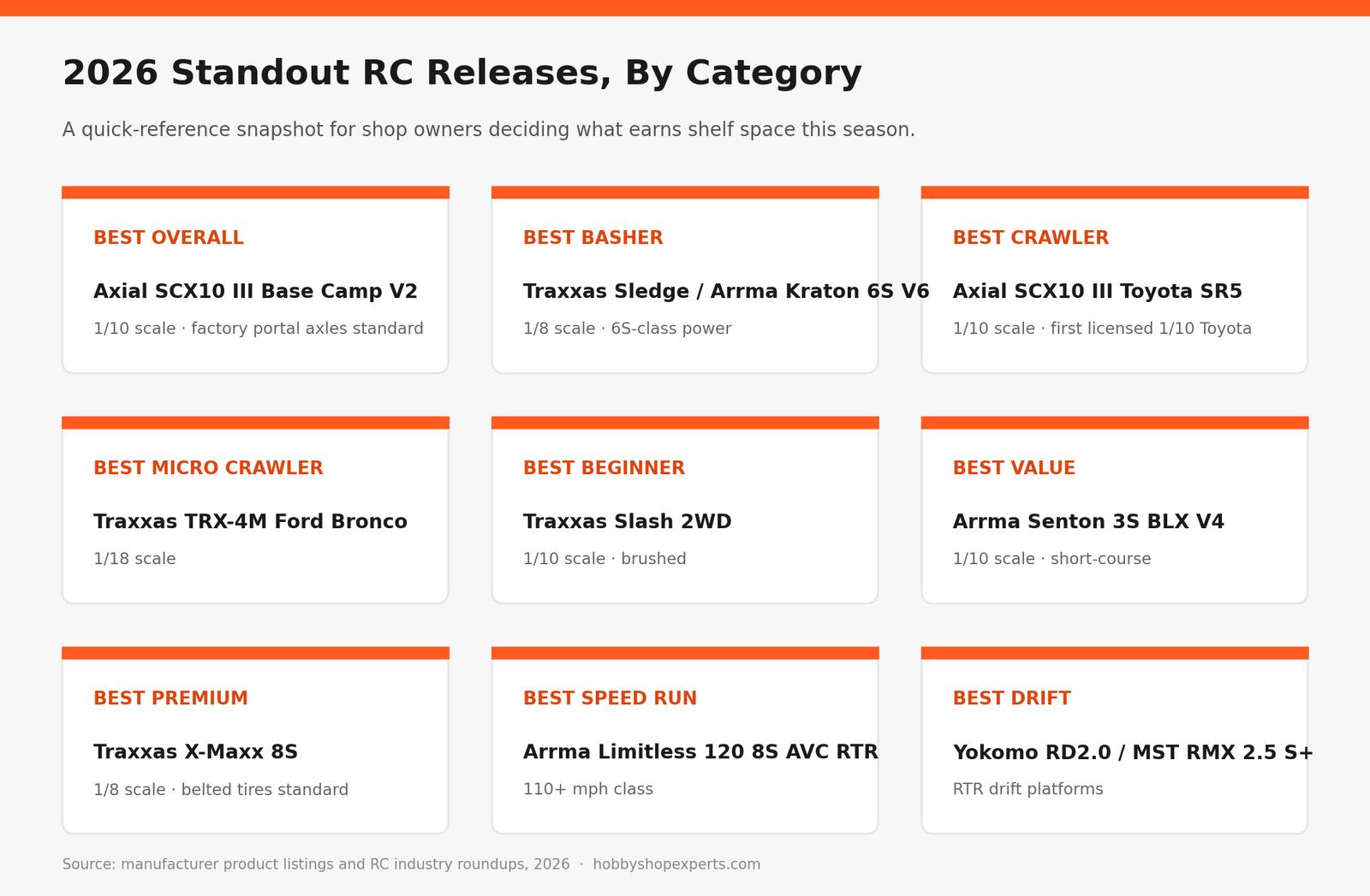
On the crawler side, Axial’s SCX10 III Base Camp platform is the one I keep coming back to. Factory portal axles as a standard feature, not an upgrade you bolt on later, is a real shift for that price point, and it’s going to change what “starter crawler” means for a lot of customers. Pair that with the newly released 1/10 Toyota SR5, which I’m told is the first officially licensed Toyota body Axial has put out, and you’ve got a legitimate reason for crawler customers to come back in even if they already own an SCX10.
Why does a licensed body matter this much?
Because it turns an existing customer into a repeat customer without you having to sell them a whole new platform. A crawler owner who already has the chassis, the electronics, and the tuning dialed in is far more likely to buy a second, third, or fourth body than a whole new truck. If you’re not tracking which licenses are landing on which chassis, you’re missing an easy, high-margin reason to bring people back through the door.
What’s Happening in the 6S Bashing Class?
If your customers lean toward bashing instead of crawling, the 1/8 scale 6S class is having a moment. The Traxxas Sledge and the Arrma Kraton 6S platform are both worth a demo unit on the counter. The Kraton’s chassis plates are using that EXB-derived 7075 T6 aluminum construction, which tells you where Arrma thinks the abuse tolerance needs to be for this class. These aren’t subtle trucks, and the customers buying them know exactly what they’re getting into.
Should a small shop even bother stocking 6S-class trucks?
If you’ve got any bashing scene at all locally, yes, at least one demo unit. These trucks sell themselves once someone sees one run in person, and they carry strong margins on accessories: bigger batteries, chargers that can handle the power draw, and replacement parts after the inevitable hard landing. The truck is the loss leader for a whole ecosystem of higher-margin add-ons.
Do Beginners Need Anything New?
For beginners, honestly, not much has changed and that’s fine. The Traxxas Slash 2WD is still doing what it’s always done as an entry point, and Arrma’s Senton 3S BLX V4 is a strong value pick if someone wants a short-course truck with more punch than a base-model basher. Don’t overthink your beginner aisle. It doesn’t need to be exciting, it needs to be reliable and easy to explain in under two minutes. If your staff can’t confidently walk a first-time buyer through the basics on the spot, it’s worth reviewing the most common questions we cover in The RC Questions I Get Asked Most so the whole team is answering them the same way.
Why Is Brushless Suddenly Everywhere Under $300?
The trend I’d actually pay attention to, if I were restocking a shop right now, is how far brushless has moved down the price ladder. It’s becoming standard equipment well under the $300 mark, which used to be brushed territory almost by default. That matters for how you talk to first-time buyers. The pitch used to be “start brushed, upgrade to brushless later.” That pitch is getting weaker every season, and shops that are still leading with it are going to sound out of date to anyone who’s spent five minutes reading spec sheets online before walking in. I go deeper on exactly why this shift is happening, and what else is moving alongside it, in Brushless Under $300, Belted Tires as Standard.
Are Belted Tires the New Standard?
On the premium end, Traxxas’s X-Maxx 8S now ships with belted Sledgehammer tires standard instead of as an add-on, and belted tires in general are becoming the expected default on high-power bashers rather than a mod. If you’ve got customers running big power and you’re still stocking their tire wall like belting is a specialty item, it’s time to rethink that shelf.
What actually changes when a tire is “belted”?
A belt reinforces the tire’s inner structure so it holds its shape under high torque and hard landings instead of squirming or tearing at the bead. For low-power bashers it’s overkill. For anything in the 6S or 8S class, it’s quickly becoming the difference between a tire that lasts a season and one that fails in a weekend.
What About Speed and Drift Customers?
If speed is the hook you use with certain customers, Arrma’s Limitless V2 Roller and the 120 8S AVC RTR are worth knowing cold, since they’re in the 110-plus mph conversation. And if drift has any following in your area, Yokomo’s RD2.0 and the MST RMX 2.5 S+ are the two names I’d expect people to be asking about.
How Should You Actually Decide What Earns Shelf Space?
I use a simple filter before adding anything new to a stocking plan, and it has nothing to do with how flashy the marketing photos look. First: is this genuinely new engineering, or is it a repaint of a platform that’s been out for three years? Second: does it fit a category my local customers actually care about, or am I chasing a trend that’s popular somewhere else but not here? Third: can my staff talk about it confidently within a week of it arriving, or is it going to sit there while everyone quietly avoids questions about it?
That third one trips up more shops than people expect. A truck that’s technically impressive but that nobody on the floor can explain well is worse than a slightly less exciting truck that your staff can sell with real confidence. Confidence is contagious at the counter, and customers can tell within about thirty seconds whether the person helping them actually understands the product or is just reading the box.
Should margin or customer demand drive stocking decisions first?
Demand first, margin second, in that order, because margin on a product nobody wants doesn’t help you. That said, once you’ve identified the handful of platforms that fit your shop and your customers, it’s worth being deliberate about which specific trims and accessory bundles you push, since that’s usually where the real margin difference shows up between two shops carrying the same core truck.
Watch: A Long-Term Look at the SCX10 III Base Camp
Spec sheets only tell you so much. This longer-term review is a useful watch if you want to see how the SCX10 III Base Camp actually holds up after real use, which is exactly the kind of detail customers researching this platform will already have seen before they walk into your shop:
Frequently Asked Questions
How many new releases should a small hobby shop actually stock?
Not all of them, and that’s fine. Pick the ones that fit your local scene, whether that’s crawling, bashing, racing, or a mix, and go deep enough on those to be the obvious local expert. A shelf that’s a mile wide and an inch deep impresses fewer customers than a tightly curated one.
Is it worth carrying demo units of expensive 6S and 8S trucks?
Generally yes, if there’s any local bashing culture at all. A truck that customers can see run in person sells far better than one sitting in a box, and the accessory margins on batteries, chargers, and replacement parts help offset the cost of keeping a demo unit on hand.
Should I wait for prices to drop on new releases before stocking them?
If a release is genuinely new and generating buzz, waiting usually just means a competitor or an online retailer captures that early demand instead of you. The first season of a hot release is often when margins and customer interest are both at their highest.
What’s the fastest way to figure out what my local customers actually want?
Ask them, and pay attention to what gets asked about most at the counter and at local events. If you’re not sure your shop is even showing up when people search for these products locally, that’s worth checking with a free store audit before you make any big buying decisions.
Know What’s New, Not Just What’s Loud
None of this means you need to carry everything. It means you should know what’s actually new versus what’s just repackaged, so when a customer asks you a direct question, you’ve got a direct answer. That’s worth more than a bigger catalog. And once you’re confident in what’s on your shelf, the next question is whether the right customers can actually find it, which is a marketing problem more often than an inventory one, as I get into in Inventory Isn’t the Problem. If you want help making sure your shop’s local search visibility matches the quality of what’s actually on your shelves, that’s exactly the kind of gap I help close.