

Why Isn’t My Hobby Shop Showing Up When Someone Asks ChatGPT for the Best RC Shop Near Them?
 By Bill BelcaminoSep 14, 202610 min read
Table of Contents
- What’s Actually Different About How AI Assistants Pick a Local Shop?
- Is This Just Local SEO With a New Name?
- What Signals Are ChatGPT, Gemini, and Google AI Overviews Actually Reading?
- Why Would a Genuinely Good Hobby Shop Still Get Skipped?
- Is Your Google Business Profile Actually Complete?
- Does Your Website Answer the Questions Hobbyists Are Typing?
- Are You Missing From the Places AI Cross-Checks?
- How Do You Actually Get AI Assistants to Start Recommending You?
- Step 1: Ask the AI What It Currently Says About You
- Step 2: Fix the Google Business Profile Fundamentals
- Step 3: Write Content That Reads Like an Answer, Not an Ad
- Step 4: Build Reviews and Citations That Establish Trust
- Step 5: Monitor, Then Repeat
- What Would This Actually Look Like for a Small Shop?
- Where Should a Hobby Shop Start With All of This?
- Frequently Asked Questions
- Is AI search optimization the same thing as local SEO?
- Which AI tools actually matter for a small hobby shop right now?
- How long does it take to start showing up in AI recommendations?
- Do I need a big website overhaul to be AI-search friendly?
- Can I check this myself before paying anyone?
A hobbyist thirty minutes from your shop just typed something into ChatGPT: “best RC shop near me for a first nitro buggy.” Or they asked Google’s AI Overview, or told Gemini to find them a hobby store that actually stocks Traxxas parts instead of just selling them online. Somewhere, an AI assistant answered that question with a name and an address. The question worth sitting with is simple: was it yours?
For years, “getting found” meant ranking on a Google results page: ten blue links, a map pack, maybe a paid ad up top. That fight hasn’t gone away. But a growing slice of local searches now get answered directly, in a sentence or two, by an AI assistant that never shows the searcher a list of websites at all. If your shop isn’t in that sentence, it’s effectively invisible to that customer, even if your Google ranking is perfectly respectable.
This isn’t a reason to panic, and it’s definitely not a reason to abandon the local SEO work you’ve already done: a strong Google Business Profile is still the foundation everything else sits on. But it is a reason to understand what’s actually changed, why a genuinely good shop can still get skipped, and what to do about it before the shop across town figures it out first.
What’s Actually Different About How AI Assistants Pick a Local Shop?
It helps to separate two things that get lumped together: traditional local search (the Google Maps pack, organic rankings) and what’s now often called AEO (answer engine optimization), or sometimes GEO (generative engine optimization). They overlap heavily, but they’re not identical, and the difference matters for what you actually do about it.
Is This Just Local SEO With a New Name?
Mostly, no. Think of it as local SEO’s close cousin. Traditional local SEO optimizes for a searcher who is going to scan a page of results and click one. AI answer engines skip that step: they read a broad set of signals about your business, decide who the “right” answer is, and hand the searcher a single recommendation (or a short shortlist) without a page of links to browse. That means there’s no second-place finish that still gets noticed. Either the AI mentions you, or it doesn’t, and the searcher never learns you were even in the running.
What Signals Are ChatGPT, Gemini, and Google AI Overviews Actually Reading?
Nobody outside the AI labs has the exact formula, but the pattern that’s emerged across early research is consistent: AI systems lean heavily on the same trust signals search engines have always used: a complete, active Google Business Profile; recent, substantive reviews; consistent business information across the web (your name, address, and phone number matching everywhere); and website content that directly answers the kinds of questions a customer would ask. Search Engine Journal’s reporting on how AI assistants choose local businesses found that these tools tend to favor businesses with clear, structured, up-to-date information over businesses with flashier but thinner web presences. In other words: the AI isn’t looking for the prettiest site. It’s looking for the site it can trust to give a straight answer.
Why Would a Genuinely Good Hobby Shop Still Get Skipped?
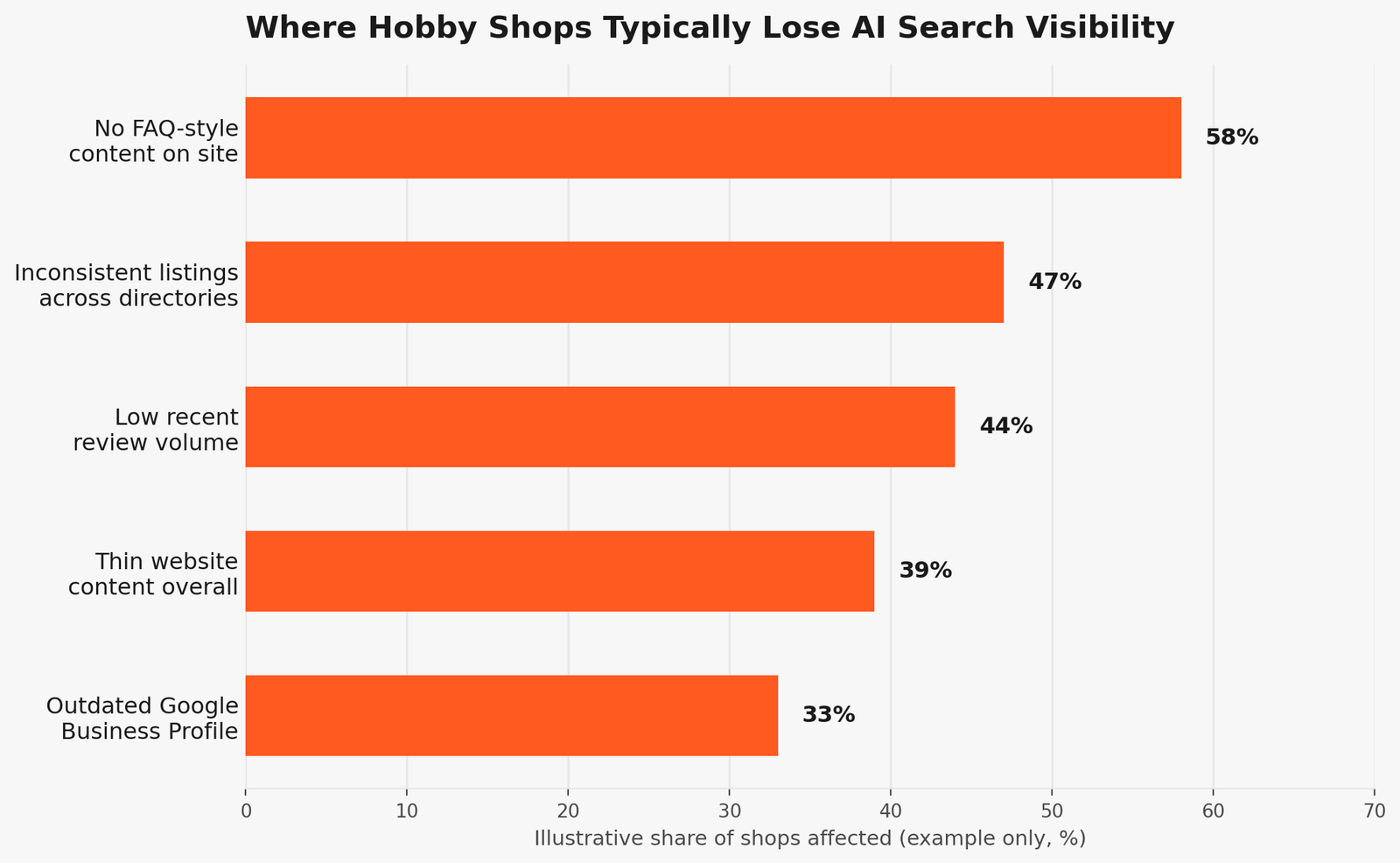
This is the part that trips up shop owners who’ve been doing “the right things” for years. You can carry the best brushless lineup in the county, run a great customer experience, and still lose an AI recommendation to a shop with a worse selection but a cleaner digital footprint. Here’s usually why.
Is Your Google Business Profile Actually Complete?
Not just claimed, but complete. Google’s own guidance on improving local ranking points to the same basics again and again: accurate categories, complete attributes, regularly posted updates, current hours, and photos that get refreshed instead of sitting untouched since your grand opening. A profile that hasn’t been touched in eight months signals something to an algorithm the same way a dusty storefront window signals something to a passerby, even if the shop inside is thriving.
Does Your Website Answer the Questions Hobbyists Are Typing?
If your site’s copy is all about your brand story and none of it directly answers “does this shop carry LiPo batteries” or “do you do RC repairs on weekends,” an AI assistant has nothing concrete to pull from when it’s trying to match your shop to a specific question. Content written in plain, question-and-answer language (the kind you’ll find further down in this post’s FAQ section) gives AI systems something clean to quote back to a searcher.
Are You Missing From the Places AI Cross-Checks?
AI tools don’t just look at your website in isolation. They tend to cross-reference multiple sources (review platforms, local directories, social mentions) to build confidence in a recommendation. If your business hours are wrong on one directory, or your shop is listed under a slightly different name somewhere, that inconsistency can quietly work against you even when everything on your own site is accurate.
How Do You Actually Get AI Assistants to Start Recommending You?
The good news is that none of this requires reinventing your marketing from scratch. It’s mostly about tightening what you’ve already got and adding a layer that speaks the language AI systems are trained to trust.
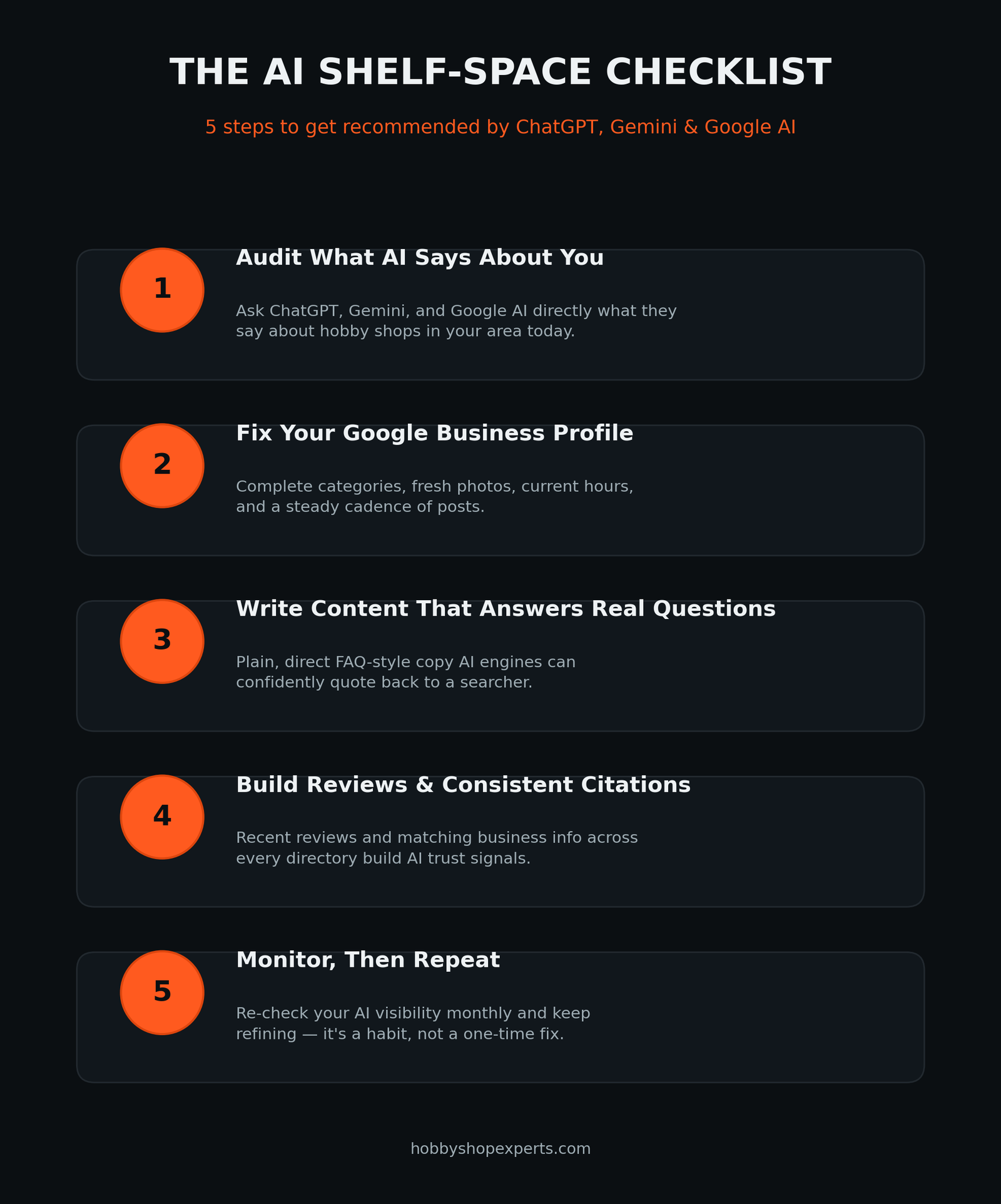
Step 1: Ask the AI What It Currently Says About You
Before fixing anything, find out where you stand. Open ChatGPT, Gemini, or a Google AI Overview and ask the exact questions a customer might ask: “best hobby shop near [your town],” “where can I buy a nitro RC car near me,” “RC repair shop near [your town].” Note whether you’re mentioned, what’s said about you, and, just as revealing, which competitors show up instead.
Step 2: Fix the Google Business Profile Fundamentals
This is still the single highest-leverage move available, and it’s the same foundation a proper local SEO and GBP cleanup is built on: correct categories, complete service and product attributes, fresh photos, and a steady cadence of Google Posts rather than a profile that’s gone quiet. A profile you update monthly reads as a business that’s actually open and active, to humans and to AI alike.
Step 3: Write Content That Reads Like an Answer, Not an Ad
Every AI-friendly piece of content on your site should be able to stand alone as the answer to a real question. That’s exactly what a well-built FAQ section does, and it’s part of why AEO/GEO-focused content structuring has become its own discipline separate from traditional keyword-driven SEO writing. Short, direct, specific answers outperform vague marketing copy every time an AI tool is deciding what to quote.
Step 4: Build Reviews and Citations That Establish Trust
Recent reviews matter more than a large stockpile of old ones. A simple, consistent ask (a QR code at checkout, a follow-up text after a repair) keeps fresh reviews coming in and gives AI systems current evidence that you’re an active, trusted business. This pairs naturally with retention touchpoints many shops already have in place through QR and email follow-up systems.
Step 5: Monitor, Then Repeat
AI search visibility isn’t a one-time project. Repeat the Step 1 check every month or two, track whether your mentions are improving, and treat it the same way you’d treat checking your Google Maps ranking: a recurring habit, not a box you check once and forget.
What Would This Actually Look Like for a Small Shop?
Picture a two-person hobby shop that’s been open eight years, has loyal regulars, but hasn’t touched its Google Business Profile since it first claimed it. As a purely illustrative example (not a real case or measured result), imagine that shop spends a month cleaning up categories and hours, posts weekly updates, asks recent customers for reviews, and adds a plain-language FAQ page answering the ten questions its counter staff hears most often. None of that is exotic work. It’s the same groundwork separates shops with a marketing problem from shops with an inventory problem: the fix is rarely about buying more stock, it’s about being findable by the people who’d already walk through the door if they knew you were there.
The shops that tend to pull ahead here aren’t necessarily the biggest; they’re the ones treating visibility as an ongoing discipline rather than a one-time setup. That’s a theme that shows up again and again in what actually separates the hobby shops that thrive from the ones that fold.
For a closer look at how AI search evaluates and ranks local businesses in practice, this walkthrough is worth eight minutes:
Where Should a Hobby Shop Start With All of This?
If you’re not sure where your shop currently stands, start with the free check described in Step 1 above. It costs nothing but a few minutes and tells you exactly where you’re being left out of the conversation. From there, prioritize the Google Business Profile fixes first, since they tend to produce the fastest movement, and layer in AI-structured content once the fundamentals are solid. Organizations like SCORE’s digital marketing and SEO resources are a solid free starting point if you want to work through the basics on your own before bringing in outside help.
Frequently Asked Questions
Is AI search optimization the same thing as local SEO?
They overlap significantly but aren’t identical. Local SEO focuses on ranking in Google’s map pack and organic results, while AI/answer engine optimization focuses on being the single business an AI assistant chooses to recommend when it answers a question directly. Strong local SEO, especially a complete Google Business Profile, is the foundation both are built on.
Which AI tools actually matter for a small hobby shop right now?
ChatGPT, Google’s AI Overviews and Gemini, and voice assistants are the ones most likely to field a “best hobby shop near me” style question today. Google AI Overviews matter most immediately since they appear directly inside the search engine most customers already use.
How long does it take to start showing up in AI recommendations?
There’s no fixed timeline, and it varies by market and competition. As a general pattern, Google Business Profile improvements tend to show measurable movement within weeks, while broader AI answer engine visibility typically builds over a couple of months of consistent activity (reviews, posts, and content) rather than appearing overnight.
Do I need a big website overhaul to be AI-search friendly?
Usually not. The highest-impact change is often adding clear, direct answers to real customer questions (an FAQ section, straightforward service pages) rather than a full redesign. Structure and clarity matter more than visual polish for this specific goal.
Can I check this myself before paying anyone?
Yes. Ask ChatGPT, Gemini, and Google directly what they say about hobby shops in your area. It’s free, takes a few minutes, and immediately tells you whether you’re part of the conversation at all.