

Why Isn’t My Hobby Shop Showing Up When People Ask AI for a Shop Near Me?
 By Bill BelcaminoSep 14, 202610 min read
Table of Contents
- What’s Actually Happening When Someone Asks AI for a Hobby Shop Near Them?
- How Different Is an AI Search From a Regular Google Search, Really?
- Does a Google Business Profile Still Matter in the Age of AI Search?
- What Makes AI Recommend One Hobby Shop Over Another?
- Why does “answering real questions in plain language” matter more than keyword stuffing?
- Why does NAP consistency (name, address, phone) matter so much?
- Can I Do This Myself, or Does It Need to Be a Bigger Project?
- Want to See How This Actually Works, Step by Step?
- How Does AI Visibility Connect to Keeping Customers Once They Find You?
- What Should a Hobby Shop Actually Do First This Month?
- Frequently Asked Questions
- Is “AEO” or “GEO” the same thing as regular SEO?
- Do I need a Google Business Profile if I already have a website?
- How long does it take to see a difference in AI search visibility?
- Do online reviews actually affect what AI recommends?
- Can a small hobby shop really compete with big retailers in AI search results?
Type “RC hobby shop near me” into ChatGPT, Google’s AI Mode, or Perplexity instead of a plain search box, and something strange happens: no map, no ten blue links, no list of pins to scroll through. Just a paragraph, usually naming two or three shops, with a short reason for each one. If your shop isn’t in that paragraph, you didn’t lose a click. You lost the whole conversation, and the customer never even knew you existed as an option.
This is the quiet shift a lot of hobby shop owners haven’t clocked yet, because it doesn’t look like “SEO” the way we’ve talked about it for the last fifteen years. It’s not really about ranking higher on a results page anymore. It’s about being the answer an AI model gives when someone asks it a question out loud, in a car, half-distracted, expecting a name and an address handed back in one breath. Let’s get into what’s actually changed, what still matters, and what a shop with limited time can realistically do about it.
What’s Actually Happening When Someone Asks AI for a Hobby Shop Near Them?
When a customer asks Google, ChatGPT, or Perplexity something like “where can I get a LiPo battery charger and have someone check my ESC,” the model isn’t crawling the web in real time the way a search engine index does. It’s drawing on a mix of things: your Google Business Profile data, review content, your website’s text (especially clearly structured pages), and any third-party mentions it can find and trust. Then it synthesizes an answer in plain language, often naming one to three businesses, and it explains why: “highly rated for RC repairs,” “carries Traxxas and Arrma parts,” “open Sundays.”
That “why” is the part most hobby shops are leaving to chance. If your website and profile don’t clearly say what you carry, what you fix, and who you serve, the model has nothing specific to pull from, so it reaches for a competitor who spelled it out.
How Different Is an AI Search From a Regular Google Search, Really?
The scale of the shift is easier to see in one number: how much a person actually types. A traditional Google search is short and keyword-driven. An AI chat prompt is a full sentence, sometimes several.
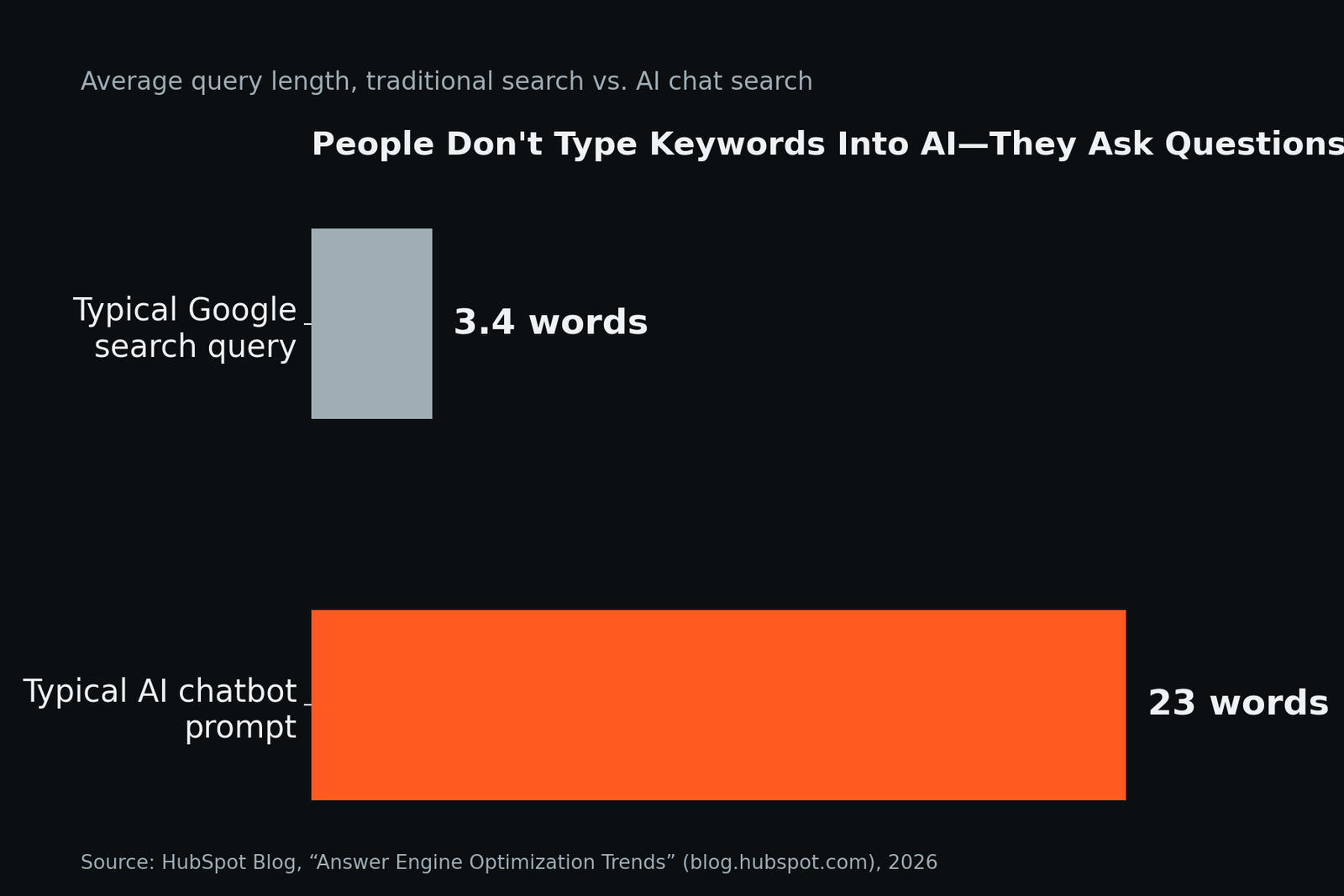
According to HubSpot’s research on answer engine optimization trends, the average ChatGPT-style prompt runs around 23 words, versus roughly 3.4 words for a typical Google search. That’s not a small gap. It means the customer is arriving with a fully-formed question (“what’s a good beginner RC truck for a 10-year-old that won’t break the first week”) instead of a fragment (“beginner rc truck”). HubSpot’s data also points to something hobby shops should care about directly: AI-discovered leads tend to convert better, because the person has already had their question partially answered and is further along before they ever call or walk in.
If your content (your website, your FAQ pages, your blog) never actually answers full questions in that conversational shape, you’re invisible to a huge and growing slice of how people search now, even if your traditional Google ranking looks fine.
Does a Google Business Profile Still Matter in the Age of AI Search?
Yes, arguably more than ever, because it’s one of the few structured, verified data sources AI models lean on heavily for local questions. An incomplete or stale profile doesn’t just hurt your map pack ranking; it means the AI has less to work with when deciding whether to mention you at all.
At minimum, that means keeping your hours accurate (especially around holidays and race-night schedule changes), your categories specific (“Hobby Shop,” not just “Toy Store”), your service area correct if you do repairs or house calls for local racers, and photos current. Google’s own Business Profile help center walks through the setup basics if you’ve never fully claimed and optimized yours; it’s free, and it’s the foundation everything else sits on top of. We go deeper on this in our local SEO and Google Business Profile service, since most shops we look at have a profile that’s technically “claimed” but only about 40% filled out.
What Makes AI Recommend One Hobby Shop Over Another?
After looking at how AI answer engines cite local businesses, a pattern shows up again and again: it rewards specificity and structure over general marketing language. Six things in particular seem to matter most for a shop our size.
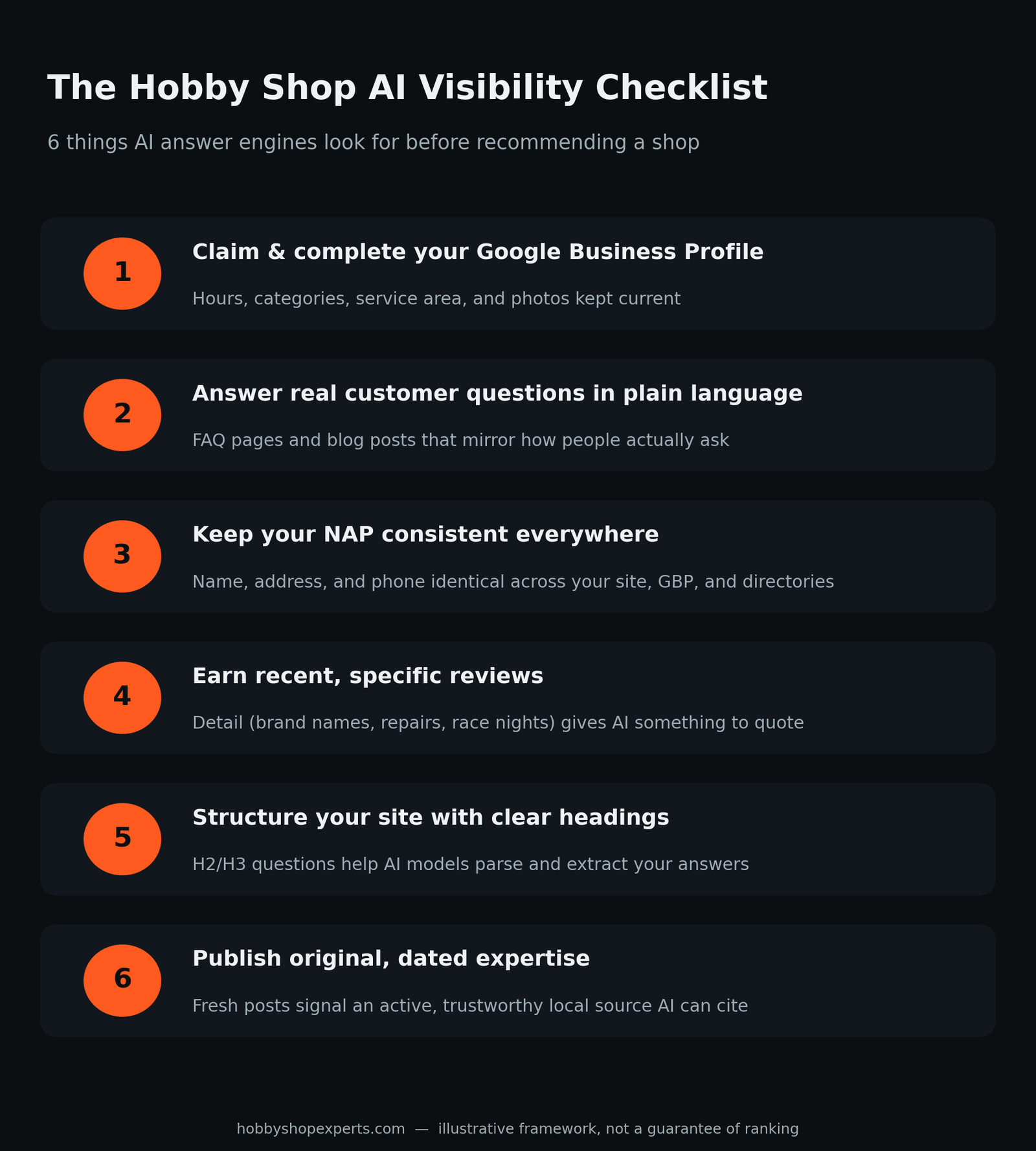
A couple of these deserve a bit more explanation because they’re easy to get backwards:
Why does “answering real questions in plain language” matter more than keyword stuffing?
AI models are built to extract direct answers, not parse marketing copy. A page that says “We’re your premier destination for all things RC” gives a model nothing to quote. A page or blog post that says “A NiMH pack typically needs 4-6 hours on a standard charger, while a LiPo pack with a balance charger usually finishes in 1-2 hours” gives it an exact, liftable answer. This is exactly the instinct behind our post covering the RC questions we get asked most at the counter. Write down the actual question a customer asks, then answer it the way you’d say it out loud.
Why does NAP consistency (name, address, phone) matter so much?
If your website says “123 Main St,” your Google Business Profile says “123 Main Street,” and a directory listing says “123 Main St. Suite B,” that’s a small inconsistency to a human but a trust signal problem to an algorithm trying to confirm you’re a real, stable business. Cleaning this up across your site, your GBP, and any directories you’re listed in (Yelp, Facebook, industry directories) is tedious but genuinely one of the highest-leverage half-days you can spend.
Can I Do This Myself, or Does It Need to Be a Bigger Project?
Plenty of it is DIY-able on a slow Tuesday: claiming and filling out your Google Business Profile completely, fixing NAP inconsistencies, and writing two or three genuinely useful FAQ-style blog posts a month. Where it gets harder is the structural side: making sure your site’s headings are actually organized the way a language model parses them, that your service pages are specific enough to be quotable, and that you’re tracking whether any of this is moving the needle.
If you want a gut-check on where your shop currently stands, we offer a free visibility audit that looks at your Google Business Profile, your site structure, and your current AI/local search presence side by side. And if this is a symptom of a bigger pattern (good product, quiet phone), it’s worth reading our piece on why inventory usually isn’t the real problem, because AI visibility is really just one more front in the same marketing fight. Our AEO/GEO and AI search optimization service exists specifically for the technical side of this if you’d rather hand it off than DIY it.
Want to See How This Actually Works, Step by Step?
If you’d rather watch this explained than read it, this walkthrough covers the mechanics of how AI answer engines like ChatGPT, Google’s AI Mode, and Perplexity decide which local businesses to surface, which is useful context even though it’s aimed at local service businesses broadly, not hobby shops specifically:
How Does AI Visibility Connect to Keeping Customers Once They Find You?
It’s worth saying plainly: getting recommended by an AI model doesn’t matter much if the customer has a mediocre first visit and never comes back. Visibility gets someone through the door once. What turns that into a repeat customer (someone who comes back for the next kit, the next battery, the next upgrade) is a completely separate system: follow-up emails, QR-code review requests at checkout, a reason to walk back in for race night. That’s a separate system entirely (follow-up sequences, review requests, a reason to walk back in for race night), and it pairs directly with the reviews piece of the AI visibility puzzle, since recent, specific reviews are also one of the six things AI models weigh when deciding who to recommend. A shop’s website matters here too; if yours is slow, outdated, or hard to navigate on a phone, it undercuts everything upstream of it.
For a broader view of what separates shops that are thriving right now from ones that are struggling, this earlier piece digs into the pattern, and AI search visibility is quickly becoming one more line item in that same list.
If you want structured, ongoing support figuring out where to start, SCORE, the nonprofit small-business mentoring network backed by the SBA, offers free one-on-one mentoring that can help you prioritize marketing spend against everything else on a small shop’s plate, it’s a genuinely useful, no-cost resource if you’re doing more of this yourself.
What Should a Hobby Shop Actually Do First This Month?
If none of this has been on your radar, don’t try to fix all six checklist items in a weekend. Start with the two that cost nothing but time: fully complete your Google Business Profile, and write down the five questions customers ask you most often at the counter, then turn each one into a short, plainly-worded page or post. That alone puts you meaningfully ahead of most local competitors, because most hobby shops haven’t touched either one since they first set up their listing.
Frequently Asked Questions
Is “AEO” or “GEO” the same thing as regular SEO?
They overlap but aren’t identical. Traditional SEO is largely about ranking a webpage in a list of search results. AEO (answer engine optimization) and GEO (generative engine optimization) are about being the source an AI model pulls from and cites when it generates a direct, conversational answer. The mechanics (structure, clarity, trust signals) are similar, but the target is different: a quoted answer instead of a ranked link.
Do I need a Google Business Profile if I already have a website?
Yes. They serve different purposes and AI models pull from both. Your website is where you can go deep and specific; your Google Business Profile is a structured, verified data source that’s especially heavily weighted for “near me” and local-intent questions, whether typed into Google or asked of an AI assistant.
How long does it take to see a difference in AI search visibility?
There’s no fixed timeline, and any shop that promises you an exact number of weeks is guessing. In general, profile and NAP fixes can influence local results within weeks, while content-based improvements (FAQ pages, blog posts) tend to build credibility more gradually as they accumulate and get cited or linked elsewhere.
Do online reviews actually affect what AI recommends?
They appear to matter quite a bit, especially reviews that are recent and specific (mentioning a brand name, a repair, or an event) rather than generic five-star ratings with no detail. Specific reviews give an AI model concrete material to reference when explaining why it’s suggesting your shop.
Can a small hobby shop really compete with big retailers in AI search results?
For local, in-person intent (“near me,” “who can fix,” “who carries in-store”, yes, often more easily than in general e-commerce search, because AI models weight local relevance and specificity heavily for those queries. A big-box retailer’s generic national page usually can’t out-specific a well-written local FAQ post about your actual repair turnaround or in-stock brands.
AI search isn’t replacing local SEO; it’s layering a new, conversational front end on top of it, and most of what makes a shop visible there is the same groundwork that’s always mattered: accurate information, genuine expertise written down clearly, and real reviews from real customers. The shops that treat this as one more channel to tend, rather than a mystery to ignore, are going to be the ones showing up in the answer, not just the search results, over the next year.