

Is Inventory Really the Problem? Why Struggling Hobby Shops Usually Have a Marketing Problem
 By Bill BelcaminoSep 9, 20268 min read
Table of Contents
- Is Inventory Really Your Problem?
- How can I tell the difference between an inventory problem and a visibility problem?
- What’s a Visibility Gap, and How Do You Know You Have One?
- What’s the fastest single fix on that list?
- Why Doesn’t Reordering Fix a Sales Slump?
- Could my problem be both inventory and visibility at once?
- How Do You Actually Fix Local Visibility?
- What Does a Genuinely Strong Google Business Profile Include?
- What’s a realistic first-month goal for someone starting from a mostly empty profile?
- Watch: Practical Local SEO Tips
- Frequently Asked Questions
- How long does it take to see results from improving local visibility?
- Do online reviews actually matter for a physical hobby shop?
- Is social media the same thing as local visibility?
- Should I hire someone for this or try to do it myself first?
- What if I’ve already done all the basics and I’m still not getting found?
If I had a dollar for every hobby shop owner who told me their problem was inventory, I could probably retire and just bash trucks full time. It’s almost never the actual problem, though. It’s the explanation that feels true because it’s the thing sitting right in front of them every day: shelves that aren’t moving, a vendor order that didn’t sell through, a competitor who seems to always have the thing customers ask for. The instinct is to fix it by buying differently. Order deeper, chase what’s trending, try to out-stock the guy across town or the big online sellers. That instinct is almost always wrong, and chasing it is how shops burn cash they don’t have to spare.
Is Inventory Really Your Problem?
Here’s the thing I’ve seen over and over doing this professionally: the shops with a real sales problem usually have plenty of the right inventory already sitting on the shelf. What they don’t have is anyone finding out about it. Nobody nearby knows the shop exists, or they think of it as “the place with the toy trucks” instead of understanding that it’s carrying serious hobby-grade gear, race support, and people who actually know what they’re talking about. That’s not an inventory gap. That’s a visibility gap, and no amount of reordering fixes a visibility gap.
How can I tell the difference between an inventory problem and a visibility problem?
Look at what’s actually selling versus what’s sitting. If specific, reasonable products are gathering dust despite being priced fairly and displayed well, that’s usually inventory or merchandising. If your whole store feels slower than it should be given what’s on the shelves, and you genuinely don’t know how many people even know you exist within a few miles, that’s visibility. Most struggling shops I’ve worked with are dealing with the second problem while convinced it’s the first. I go through the broader pattern of what separates shops that catch this early from ones that don’t in What Separates the Hobby Shops That Thrive From the Ones That Fold.
What’s a Visibility Gap, and How Do You Know You Have One?
I’ll give you the blunt version: if your shop isn’t showing up when someone in your town searches for RC cars, hobby shop, or the specific brands you carry, you are invisible to the exact customers who are actively trying to spend money with you right now. Not eventually. Right now, today, someone in your area is probably searching for something you already have in stock, and finding a big box store’s website or a competitor three towns over instead of you, because your online presence hasn’t kept pace with your actual shop.
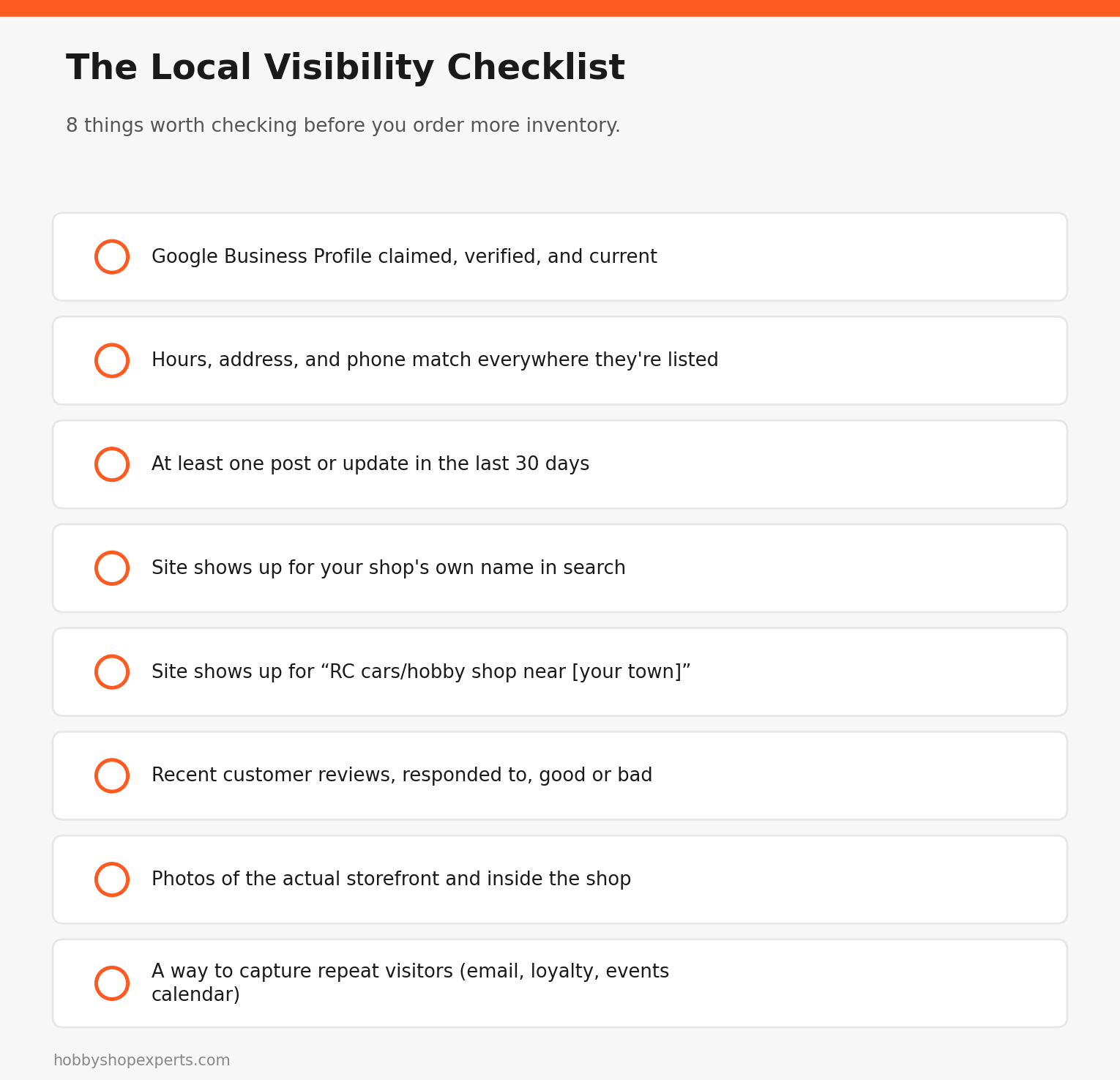
I built a simple checklist to help shop owners self-diagnose this instead of just guessing.
What’s the fastest single fix on that list?
Claiming and fully completing your Google Business Profile. It’s free, it’s usually the very first thing a nearby customer sees when they search, and an overwhelming number of small shops either never claim it, leave it half-filled out, or let the hours and photos go stale for years. Google’s own guide to improving local ranking is a genuinely useful starting point if you want to tackle this yourself before bringing in help.
Why Doesn’t Reordering Fix a Sales Slump?
Because the customer who would have bought that inventory never found out it existed in the first place. You can double down on the exact right product mix and it won’t matter if the people searching for it in your area are landing on someone else’s website or Google listing instead of yours. Ordering deeper when the real problem is findability is like turning up the volume on a radio nobody’s tuned into.
Could my problem be both inventory and visibility at once?
Sure, it happens. But fix visibility first, because it’s usually cheaper and faster than a full inventory overhaul, and it tells you the truth about your actual demand. Once the right customers can find you, you’ll get much clearer, faster signal about which products are genuinely underperforming versus which ones were just never given a fair shot with real foot traffic. For a sense of what’s currently worth stocking once your visibility is solid, see What’s Actually Worth Stocking This Fall.
How Do You Actually Fix Local Visibility?
The fix isn’t glamorous. It’s making sure your shop shows up correctly on Google, keeping your hours and inventory highlights current, posting consistently about what’s happening in the store rather than only when you remember to, and being findable by the actual language customers use when they search, not just the brand names you think in. None of that requires a bigger vendor order. It requires treating your shop’s visibility as seriously as you treat your shelf planning. This is essentially what our local SEO and Google Business Profile service exists to handle for shop owners who’d rather spend their time on the floor than in search console dashboards.
There’s also a longer-term layer to this worth knowing about: how AI-driven search and chat assistants surface local businesses is shifting fast, and shops that get ahead of it now have a real advantage. That’s a newer, more technical piece of the visibility puzzle we cover under AI search optimization.
What Does a Genuinely Strong Google Business Profile Include?
It’s more than just an address and a phone number. A complete profile has current hours (including holiday hours, which shops forget constantly), a real description that mentions the specific brands and categories you carry, photos that are updated at least seasonally rather than left from your grand opening, and a steady trickle of recent reviews rather than a pile from three years ago. It also means actually responding to reviews, good and bad, since that activity itself is a signal that the business is active and attentive.
Posts within the profile itself, short updates about events, new arrivals, or seasonal promotions, are an underused feature that most competitors aren’t bothering with. They’re a low-effort way to keep showing up as active in a way that search engines and potential customers both notice.
What’s a realistic first-month goal for someone starting from a mostly empty profile?
Getting the basics fully filled in, hours, categories, a real description, and at least ten to fifteen current photos, is a solid first-month target. From there, focus on generating a steady stream of new reviews rather than trying to do everything at once.
Watch: Practical Local SEO Tips
If you want to start tackling this yourself before deciding whether to bring in outside help, this is a solid, practical walkthrough of concrete steps for improving local search visibility:
Frequently Asked Questions
How long does it take to see results from improving local visibility?
Some improvements, like completing a Google Business Profile properly, can show up in local search within weeks. Others, like building a broader base of reviews and consistent posting history, compound over several months. It’s rarely instant, but it’s also rarely as slow as shop owners fear.
Do online reviews actually matter for a physical hobby shop?
Significantly. Reviews are one of the strongest signals both to search engines and to potential customers deciding between you and a competitor. A shop with a handful of stale reviews from years ago is quietly losing ground to any competitor actively collecting fresh ones.
Is social media the same thing as local visibility?
Related but not the same. Social media helps with awareness and community-building among people who already know you exist. Local search visibility is about being found by people who don’t yet know you exist and are actively searching. A healthy shop needs both, but they solve different problems.
Should I hire someone for this or try to do it myself first?
If you have the time and patience to learn it, plenty of the basics, like the Google Business Profile setup, are genuinely doable yourself with free resources. Where outside help usually pays for itself is in the ongoing consistency and the more technical pieces, which is exactly the gap a free store audit can help you identify before you commit time or money either way.
What if I’ve already done all the basics and I’m still not getting found?
That’s usually a sign it’s time to look at the more technical layer: how your website itself is structured, whether it loads quickly, and increasingly, whether AI-driven search tools and assistants can understand what your shop actually offers. That’s a newer front in local visibility, and it’s exactly why we built out a dedicated AI search optimization service rather than treating traditional local SEO as the whole picture.
I’d rather see a shop with tight, well-curated inventory and strong local visibility than a shop drowning in SKUs that nobody can find. One of those is a sustainable business. The other is just expensive storage.