

Why Do I Still Get Butterflies Charging My First Battery Pack of the Season?
 By Bill BelcaminoAug 31, 20269 min read
Table of Contents
- What Makes RC Impossible to Quit?
- Is it really about the truck, or something else?
- Why Do Hobby Shop Owners Need to Understand This Feeling?
- How can a shop actually sell “the feeling”?
- What Should Shop Owners Learn From Their Own Customers?
- What’s the single biggest mistake shops make with new hobbyists?
- How Do You Keep the Feeling Going All Season?
- Frequently Asked Questions
- Why do RC hobbyists stay loyal to this hobby for decades?
- What’s the best way for a shop to help someone catch “the bug” on their first visit?
- Is it normal to take a long break from RC and come back to it?
- Does the “first battery of the season” feeling ever actually go away?
- Watch: A Quick Reminder on Battery Care
- The Actual Product You’re Selling
I charged a battery pack last weekend before a Saturday morning bash session, and I caught myself grinning at the little LED blinking through its charge cycle like it was the first one I’d ever plugged in. I’ve been doing this for a long time. I should be past the point of getting excited about a battery.
I’m not, and I don’t think I ever will be. If you’ve felt that same small jolt of anticipation before a run, you already know exactly what I’m talking about. If you haven’t yet, stick around, because understanding why this feeling exists is honestly the whole secret to running a hobby shop that people come back to.
What Makes RC Impossible to Quit?
There’s something about this hobby that doesn’t wear off the way most hobbies do. Maybe it’s that every truck, buggy, or crawler is a little different depending on how you’ve set it up, so you’re never really doing the same thing twice. Maybe it’s that it forces you outside, in a parking lot or a backyard or an actual track, instead of in front of another screen. Or maybe it’s just that the first pass of the season, when the weather finally cooperates and you pull the rig out of the garage, still feels like the first time.
I got into this the way a lot of people do: a truck as a kid that I destroyed within a month, a rebuilt one that lasted longer because I actually learned how it worked, and then a slow slide into caring more about gearing ratios and shock oil weight than I probably should. Somewhere in there it stopped being a toy and started being a thing I do on purpose, on a schedule, with people I look forward to seeing.
Is it really about the truck, or something else?
It’s something else. Ask any longtime hobbyist why they still show up on a Saturday and almost none of them will say “because I like plastic and metal.” They’ll talk about the group of people at the track, the satisfaction of a repair they figured out themselves, the kid down the street who asked to watch, or the pure stupid joy of watching something you built go faster than it has any business going. The truck is the excuse. The feeling is the product.
Why Do Hobby Shop Owners Need to Understand This Feeling?
That’s the part I want hobby shop owners to sit with for a second, because it’s easy to lose sight of when you’re behind a counter all day worrying about margins and vendor minimums. The people walking through your door aren’t buying a plastic truck. They’re buying the Saturday. They’re buying the version of themselves that gets to stand in a parking lot with friends, break something, fix it, and try again. If your shop only sells the object and not the experience around it, you’re leaving the best part of this business on the table.
I’ll be honest, I didn’t fully appreciate that until I started working with hobby shops professionally, years after I’d already been a customer at plenty of them. The shops that stuck with me weren’t the ones with the deepest inventory. They were the ones where somebody remembered what I was running, asked how the last race went, and pointed me toward a part I didn’t know I needed. That’s not a marketing tactic. That’s just paying attention to people who share your obsession. If you want a longer breakdown of exactly what separates those shops from the ones that quietly close their doors, I wrote about it in detail in What Separates the Hobby Shops That Thrive From the Ones That Fold.
How can a shop actually sell “the feeling”?
You can’t put a feeling on a shelf, but you can build a store around creating more chances for people to have it. That means recurring events on a schedule people can actually plan around, staff who ask about the last build instead of just ringing up the next one, and a willingness to let customers linger and talk shop instead of rushing them to checkout. None of that shows up on a P&L statement directly, but it shows up six months later when that same customer skips the big-box aisle and drives across town to see you instead.
What Should Shop Owners Learn From Their Own Customers?
Here’s an exercise I give shop owners when I’m working with them: think back to your own first battery pack, your own first truck, the moment this hobby hooked you personally. Now ask yourself honestly whether a first-time customer walking into your shop today could have that same moment. If the answer is no, that’s not a marketing problem you fix with a better logo. That’s a floor-experience problem, and it’s usually fixable with people, not money.
A lot of what I help shops with under our retention and email marketing services is really just formalizing this instinct. Once a customer has that first spark, the shops that thrive make sure it doesn’t fade the moment they walk out the door. A well-timed “how’s that build coming along” email, or a QR code at checkout that invites someone to the next race night, keeps the relationship alive between visits instead of hoping they remember you exist next time they need a part.
What’s the single biggest mistake shops make with new hobbyists?
Treating them like a transaction instead of a recruit. Someone buying their first RC car is at the most impressionable moment of their entire relationship with this hobby. If the RC questions they have right after that purchase go unanswered, or feel like a hassle to ask, a lot of them quietly drift away within a season. I keep a running list of the most common ones shop staff get asked in The RC Questions I Get Asked Most, and it’s worth having your floor staff genuinely comfortable answering every one of them without hesitation.
How Do You Keep the Feeling Going All Season?
Every hobby has a natural rhythm, and RC’s rhythm is seasonal in a lot of markets: a slow build in spring, a peak through summer, a fall push before weather turns, and a quieter winter where the diehards move indoors or start planning next year’s build. Shops that treat every season the same way miss chances to re-create that first-battery feeling on a schedule. A “first bash of spring” event, a fall clearance-and-upgrade weekend, a winter build clinic for people finally getting around to that kit that’s been sitting in a box, these are all just ways of manufacturing more first-battery moments throughout the year instead of waiting for customers to generate their own enthusiasm.
Frequently Asked Questions
Why do RC hobbyists stay loyal to this hobby for decades?
Because it keeps evolving with the person. A beginner truck teaches basic driving and simple maintenance. A few years in, the same person might be tuning shocks, learning to solder, or getting into racing. The hobby has enough depth that it grows with you instead of getting boring once you’ve “beaten” it, the way a lot of consumer products do.
What’s the best way for a shop to help someone catch “the bug” on their first visit?
Slow down the sale. Ask what they actually want to do with the truck, whether that’s bashing in a backyard or racing on a track, and match the product and the accessories to that use case instead of upselling the most expensive option. A five-minute conversation that sets someone up for a genuinely good first experience is worth more in referrals than any single sale.
Is it normal to take a long break from RC and come back to it?
Extremely normal, and it’s something shops should plan for rather than treat as lost business. Life gets busy, priorities shift, and people step away for a season or a decade. The shops that keep in touch, even loosely, are the ones that get that person back in the door once the itch returns.
Does the “first battery of the season” feeling ever actually go away?
Not for the people who stay in this hobby long-term, in my experience. It might get quieter, but it doesn’t disappear. If anything, it becomes one of the more reliable small joys in a hobbyist’s year, which is exactly why it’s worth building a business around protecting it.
Watch: A Quick Reminder on Battery Care
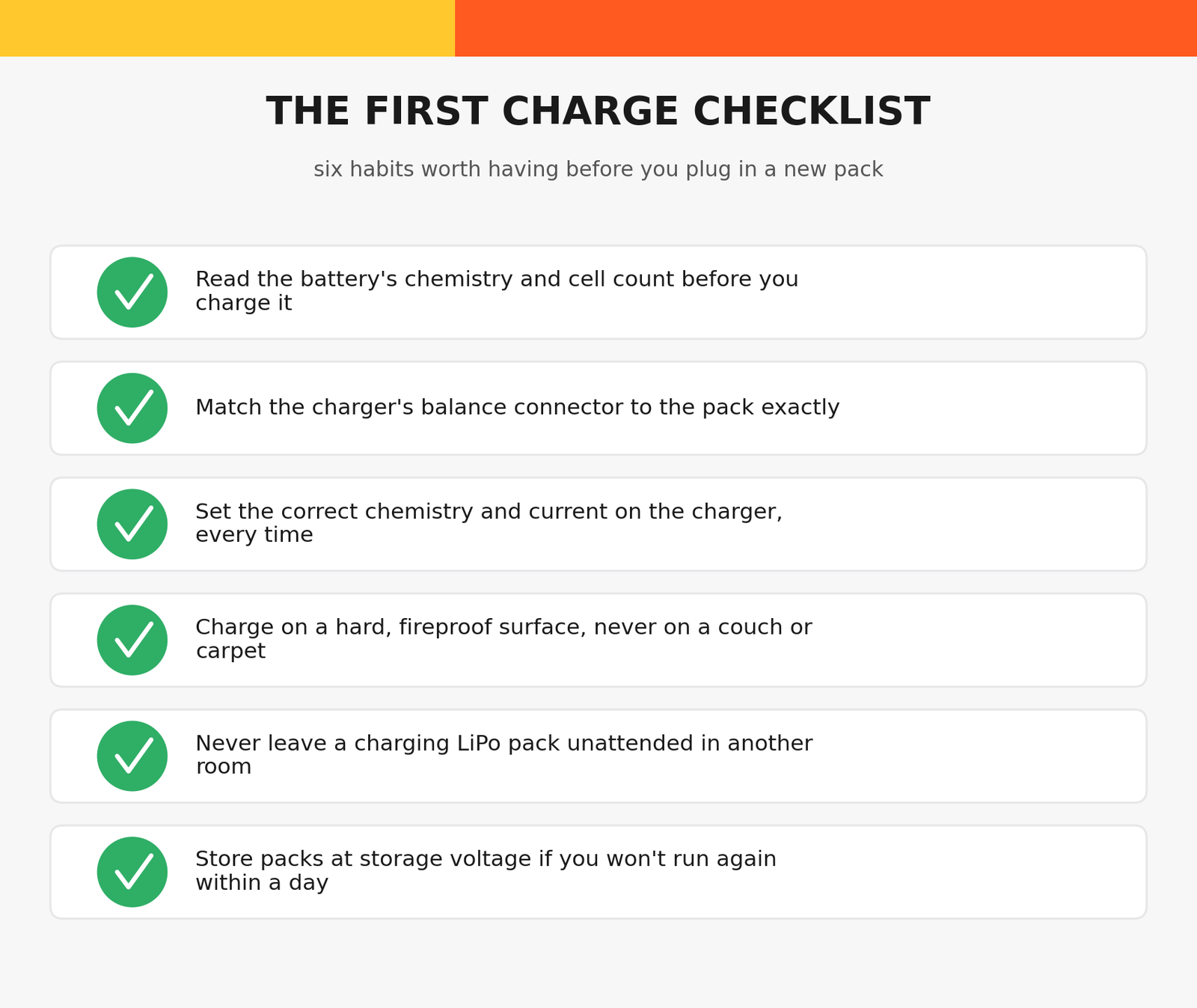
Since we’re on the subject of that first battery of the season, it’s worth a quick refresher on doing it safely, especially if you’re advising newer customers on their first pack. This short video covers the basics of balance charging cleanly:
For a deeper technical breakdown of how lithium battery charging actually works, Battery University’s guide on when and how to charge is one of the more thorough resources on the topic, and it’s a good one to keep bookmarked for your own reference behind the counter.
The Actual Product You’re Selling
So yeah, I still get a little charge (sorry) out of plugging in that first battery of the season. If you’re in this business, or thinking about getting into it, that feeling is the actual product. Everything else, the parts, the accessories, the events, is just the delivery mechanism. If you want a second opinion on whether your shop is currently set up to deliver that feeling consistently, or whether customers are quietly slipping past you toward someone else’s storefront, that’s exactly what I dig into during a free store audit and strategy call. No pitch, just a real look at what’s working and what isn’t.
I keep this blog going for the same reason I keep this business going, because I genuinely love this stuff, and I’ve spent enough years around it (bio and background on the About page) to have opinions worth sharing. More soon. I’ve got a truck to finish rebuilding.